Pull-Through vs. Back-In RV Sites: Which One Fits Your Rig?
QUICK ANSWER: A pull-through site lets you drive straight in and straight out with no reversing, which is why big rigs, one-night stays, and solo travelers often prefer them. A back-in site usually offers more privacy, a quieter spot away from the entrance road, and sometimes a better view, but it asks you to back your rig into place. The right choice comes down to your rig length, how much backing experience you have, whether you're towing a vehicle, and how long you're staying.
Water
What Actually Separates These Two Site Types
The difference sounds simple, and mostly it is, but the details matter once you're standing at the gate with a 34-foot fifth wheel behind you.
A back-in site is open on one end only. You pull past it, then reverse your rig into the space so the back of the RV faces the interior of the site and the front faces the road. Every RV type can use one, from a small travel trailer to a Class A motorhome, but the maneuver takes practice, especially in tight rows with trees, picnic tables, or neighboring rigs close by.
A pull-through site is open on both ends. You drive in from one side and, when it's time to leave, you continue forward and exit the other side. There's no backing required to arrive, and none to depart. That single feature is the whole reason pull-throughs carry a reputation as the easier, lower-stress option, particularly for anyone still building confidence behind the wheel of a longer rig.
Site shape isn't always as clean as the definitions suggest, either. Some campgrounds label curved or angled sites as pull-throughs when they're really only usable that way by shorter rigs. A long motorhome or a truck-and-trailer combo can still find itself unable to make the turn without swinging wide, so it pays to ask about the actual site layout rather than assuming every pull-through works the same way for every rig length.
The Case for a Pull-Through Site
Pull-through sites earn their popularity for a handful of practical reasons that go beyond simply avoiding a tricky maneuver.
If you're towing a car behind your motorhome, backing up usually isn't an option at all without unhooking it first. A pull-through means you can leave the tow vehicle connected the entire time you're parked, which saves real time and hassle on arrival and departure day. The same logic applies to a truck pulling a travel trailer when you'd rather not disconnect and reposition the tow vehicle separately.
Arrival timing matters too. If you're rolling in after a long travel day, tired, distracted, and losing daylight, a pull-through takes one variable out of the equation. You won't be squinting into side mirrors trying to judge clearance around a picnic table in the dark.
Pull-through sites also tend to run longer and wider than back-in sites. That extra room helps with parking, with extending slide-outs, and with setting up outdoor gear without feeling boxed in. Campgrounds often place them in sections built to handle bigger rigs, so if your rig runs long, a pull-through frequently solves two problems at once: fit and ease of parking.
But none of this makes a back-in site the lesser choice. It just means pull-throughs solve a specific kind of travel-day headache.
The Case for a Back-In Site
Plenty of experienced RVers request back-in sites on purpose, and not just because they're comfortable with the maneuver.
Back-in sites are frequently tucked further from the main road, which can mean less through-traffic noise and more separation from other guests. If quiet evenings and a sense of privacy rank high on your list, a back-in spot away from the busiest lanes of the campground is often the better fit.
Site orientation is another factor. Backing in gives you more control over exactly where your door, awning, or slide-out ends up relative to shade, sun angle, or a view you want to face. With a pull-through, you're limited to whichever direction the site runs. With a back-in site, a little extra effort during setup can land you facing the direction you actually want.
There's also a simple argument for building the skill. Every RVer who tows or drives a larger rig eventually hits a stretch of travel where every open site is a back-in one.
Treat each stay as low-stakes practice. Do it in daylight, with a spotter, and it turns from a stressful skill into a routine one.
Tip: When you call or book a back-in site, ask which direction you'll be approaching from and whether the site can sit on your driver's side as you pull up. It's a small detail, but it means you'll be backing in while watching your own mirror instead of relying entirely on a spotter you can't see, and it makes the whole maneuver noticeably calmer.
Matching the Site to Your Rig and Travel Plans
The best choice usually depends less on preference and more on the specifics of your trip.
Rig Length And Configuration
Longer motorhomes, especially those towing a car, and long fifth-wheel combinations generally have an easier time in pull-throughs. Shorter travel trailers and smaller rigs can comfortably manage either type, which gives their owners more flexibility to prioritize location or price over ease of parking.
Length Of Stay
For a single overnight on a travel day, the convenience of a pull-through often outweighs everything else, since you'll be setting up and breaking down within hours of each other. For a week-long or monthly stay, many travelers are willing to take on a back-in site in exchange for a quieter location, since the setup effort is a one-time cost spread across a much longer visit.
Travel Companions
Solo travelers without a spotter tend to lean toward pull-throughs simply because backing up alone, using only mirrors or a backup camera, adds difficulty. Traveling with a partner or friend who can spot for you narrows that gap considerably.
Arrival Conditions
If you expect to roll in after dark, during rain, or at the tail end of a long driving day, a pull-through removes one more variable from an already tiring stretch.
None of these factors are absolute rules. They're simply the questions worth asking yourself before you book, so the site you reserve actually matches how you'll be arriving and how long you'll be settled in.
What to Ask Before You Book
A site's label only tells you part of the story. A few questions to a campground before you commit can save you a stressful arrival. Ask for the actual site dimensions, depth and width both, not just the general size class the site falls under. Find out whether a pull-through is straight or curved, since a sharply curved one can be nearly impossible for a long rig to actually pull through without cutting the interior corner. Ask what sits near the site itself: low branches, utility pedestals, fire rings, or landscaping that narrows the usable path once you're lined up.
Two more matter just as much. Is the site level, or does it need a stack of leveling blocks to compensate for slope? And if quiet evenings matter to you, how close does it sit to through-traffic, common areas, or the entrance gate?
Getting straight answers to those questions matters more than the pull-through-versus-back-in label itself. A well-placed back-in site with generous clearance can be far easier to manage than a tight, curved pull-through.
Backing In With Confidence When You Don't Have a Choice
Sooner or later, most RVers end up with a back-in site, whether by choice or because it's the only option left. A few habits make the process far less stressful.
Scout the site on foot before you attempt to back into it. Walk the space with whoever is spotting for you and look for anything that didn't show up from the road: low branches, drainage dips, exposed roots, or a picnic table positioned closer to the edge than expected.
Agree on hand signals or use two-way radios with your spotter before you start moving, not after. Simple, consistent signals for stop, slow down, and steering direction prevent the kind of confused shouting that stresses everyone out and draws an audience.
Position the site on your driver's side whenever the campground layout allows it, so you can watch your own mirror instead of relying entirely on a spotter you can't see well. Many RVers also use a swooping approach, angling wide before the turn, to reduce how sharp the final backing angle needs to be.
Above all, go slowly. A towed trailer reacts to steering input with a short delay, and rushing the process is what turns a minor correction into a jackknife. If you lose sight of your spotter at any point, stop the rig completely until you can see them again.
Warning: Before you hook up water, sewer, or power at any site, confirm the ground beneath your tires is firm and reasonably level, particularly after heavy coastal rain. Soft or saturated ground can shift under a leveled rig, and forcing hookups onto an unstable connection point can strain fittings or damage your RV's plumbing and electrical connections. Take the extra few minutes to check stability before you fully commit.
Bringing It All Together on the Forgotten Coast
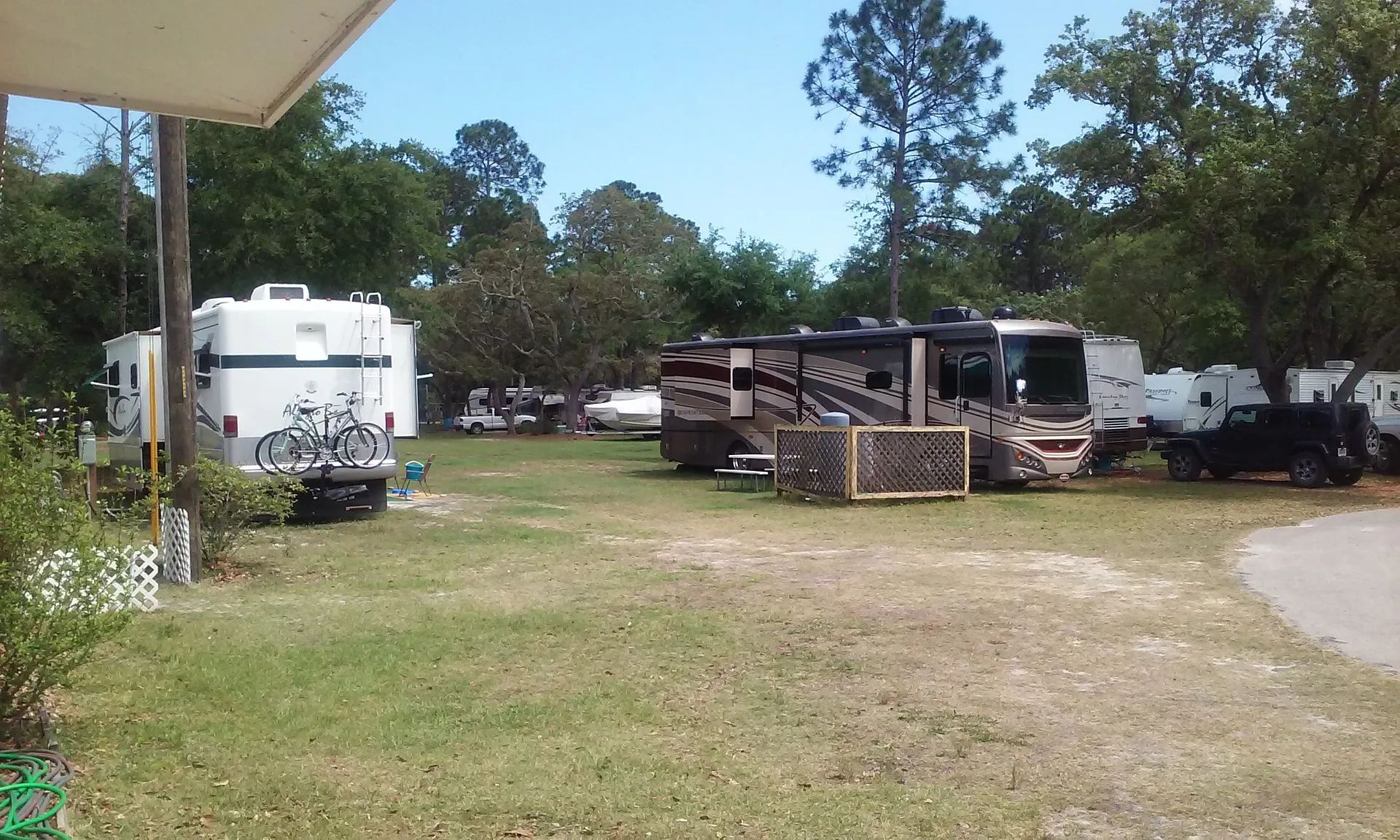
Along Florida's Forgotten Coast, where salt air, sandy soil, and mature live oaks shape the terrain, site selection carries a little extra weight. Coastal ground can drain differently after a fast-moving Gulf storm than it does inland, and low-hanging branches near mature trees are a normal part of a shaded, established campground rather than a flaw. Factoring those regional details into your pull-through-versus-back-in decision, alongside your rig length and travel plans, sets you up for a smoother arrival no matter which type of site you land in.
Travelers heading through this stretch of the Panhandle for fishing, scalloping season, or simply a slower pace by the water tend to appreciate campgrounds that keep both site types available and clearly described, so the choice actually matches the trip. Whether you're passing through for one humid summer night or settling in for a longer stretch during cooler months, matching your site type to your rig and your patience level makes the whole stay easier from the moment you arrive.
Frequently Asked Questions
Are pull-through sites available for every RV type?
Yes. Any RV can use a pull-through site, though very long rigs should confirm the site's actual length and shape rather than assuming every pull-through accommodates every size comfortably.
Is a back-in site harder to level than a pull-through?
Not really. Leveling difficulty comes down to the ground and slope of the individual site, not the site type. Some back-in sites sit perfectly flat, and some pull-throughs have more slope than you'd expect.
Can I request a specific site orientation ahead of time?
Many campgrounds will note site preferences when you book directly, especially for details like driver-side entry or proximity to quiet areas. It's always worth asking when you reserve.
Should I request a site type when I book, or wait and see what's open?
Request it up front if you have a preference. Popular pull-through sites and the quietest back-in spots tend to fill first, especially during busy travel seasons, so naming what you want at booking time gives you the best shot at getting it.
What's the single biggest factor in choosing between the two?
For most travelers, it comes down to rig length combined with whether you're towing a separate vehicle. Those two factors alone answer the question for a large share of RVers before any other preference even comes into play.
Choosing the Site That Fits Your Journey
The choice between pull-through and back-in ultimately comes down to knowing your rig, your comfort level, and what you want out of the stay. A quick overnight favors ease and speed, while a longer visit often rewards the quiet and privacy a back-in spot provides. Neither option is inherently better than the other; they simply serve different travel needs. Once you understand what each site offers, matching one to your plans becomes far less complicated than it first appears.
Panacea RV Park, located in Panacea, FL, has spent 40
years helping travelers navigate exactly this kind of decision along the Forgotten Coast. From long rigs towing a second vehicle to first-time back-in attempts under shaded live oaks, every stay comes with its own small set of variables worth thinking through. With the right site type and a little preparation, arrival day feels far less like a challenge and more like the easy start to a good stretch by the water.